
April 7th
Two Formats of Partnership

The Summit of the Visegrad Group, held in Budapest, with the participation of all engaged members with the EU program “Eastern Partnership” gave a good ground to compare the two formats of cooperation and the analysis of some results of European initiative development. READ MORE
Global World and Nuclear Security

Just in a month we will celebrate the anniversary of the Second World War ending. There are millions of people in the world, who participated in the battles of the middle of previous century. But the difference between the history and modernity, as a former US Vice-President Walter Mondale noted wittily, is that “there will be no veterans of the third world war”. READ MORE
Ukraine scraps NATO accession plans

The Ukrainian president has dissolved the commission which was to work towards NATO membership. It's the latest move to abandon the pro-western stance of the 'Orange Revolution' and re-establish ties with Russia. READ MORE
Is Russia finally ditching its revisionist history on Katyn?

In this era of commerce and trade, it often happens that countries that might once have gone to war play out their antagonisms through other means. The immigration debate plays this role in Mexican American relations. For a time, the trade dispute over soft wood lumber (yes, really) fulfilled this function in Canadian American relations: At stake were different attitudes toward the role of government in industry, Canada's sensitivity to American economic power and many other issues, though you wouldn't know it if you weren't paying attention. READ MORE
April 5th
Minsk – Vilnius: Thaw Time

Extension of contacts between official bodies in Minsk and Vilnius creates favorable conditions for the development of Belarusian-Lithuanian cooperation. But disagreements on a number of political issues still exist. READ MORE
April 2nd
Azerbaijan Arranges “Zurich-2” – Operation

Turkish State Minister Ali Babacan made an intriguing declaration in Brussels: "I was one of the authors of Zurich protocols signed with Armenia and there we reached a clear agreement that the Parties will discuss within historic committees the issues over the events of 1915. And we were ready to any results of these commissions activity". By this Babajan underlined, that Azerbaijan and other states were informed in details about Armenian-Turkish negotiations in Zurich: "I’ll say more, after we agreed with Armenia in Munich to sign protocols, I went not to Ankara, but to Baku, where I specified the position of Turkey on these issues to the President Ilham Aliyev". READ MORE
March 31st
The UN Accepts CSTO as a Regional Security Organization

On March 18, in Moscow, United Nations Secretary-General Ban Ki-moon and the Collective Security Treaty Organization’s (CSTO) Secretary-General, Nikolay Bordyuzha, signed a declaration on cooperation between the two secretariats. The document, and the UN’s steps preceding it, can be interpreted as UN recognition of this Russian-led bloc in the “post-Soviet space.” The Russian side will doubtlessly construe the UN’s blessing as a full and unambiguous recognition of the CSTO (Russia, Belarus, Armenia, Kazakhstan, Kyrgyzstan, Tajikistan, and Uzbekistan). READ MORE
Lithuanian Foreign Minister Visits Georgia
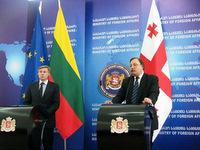
On March 27 new Lithuanian Foreign Minister Audronius Azubalis began a three-day official visit to Tbilisi. On Saturday he met Georgian Parliament Speaker Davit Bakradze and discussed the further intensification of the relations between the two countries in various international formats and the participation of Lithuanian observers at the forthcoming Georgian local elections. READ MORE
March 29th
Collective Defense in Central Asia Contradicted by Rising National Spending

Despite the impact of the global economic crisis on all of the economies within the former Soviet Union, averaging a 7 percent decline in GDP in 2009, defense spending has increased in each state with the exception of Belarus (which remained unchanged in 2009 year-on-year at 1.5 percent of GDP). Defense spending, according to an extensive analysis in Nezavisimaya Gazeta, witnessed the sharpest increase in Georgia (4.56 percent of GDP), Armenia (4.07 percent) and Azerbaijan (3.95 percent). In the case of Armenia, this level of defense expenditure proved surprising in the context of its 15 percent decline in GDP in 2009. READ MORE
We do our best to exploit huge cooperation potential between Kazakhstan and Austria fully - Ambassador Kazykhanov

Austria is known to each Kazakhstani not only as the OSCE headquarters location and one of the most beautiful European landscapes, but first of all as the state rich in cultural traditions and historical heritage, the motherland of prominent rulers, scientists, philosophers and composers. Modern Austria is one of the most developed European states possessing significant international reputation, powerful production, scientific-technological, innovative and investment capacities. READ MORE

